
'We don't know what the reasons were that we gave back the Haji Pir Pass which was strategically very important. Today the entire infiltration into Kashmir takes place from that area. If we had retained that post that we had captured, things could have been different.' 'A lesson we need to learn is if you start losing the gains of war at the negotiating table, they become a disincentive for future wars,' says Lieutenant General D B Shekatkar (retd), reviewing the lessons from the 1965 War.

10 Heroes of the 1965 War which ended on September 23 60 years ago.
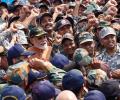
'Had Haji Pir and/or Skardu been taken, the message would have gone out not just to General Asim Munir and his cohort in the Pakistan army but to the Pakistani people that every terrorist incident in India would lead to substantial loss of territory in PoK.'
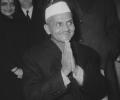
The high point of the 19 Shastri months was the 22-day war that he fought against great odds and won in principle, even if military historians often call it a stalemate. Pakistan saw a great opportunity to conquer Kashmir and lost. It was the last time they had the relative strength militarily and diplomatically to take Kashmir. Shastri's resolve buried that dream forever, points out Shekhar Gupta.
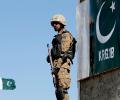
The Pak army also claimed that three Indian soldiers were killed in the exchange of fire. An Indian JCO was killed in Pak firing on Wednesday.

Pakistan on Monday lodged a protest over what it described as an 'unprovoked Indian attack' on one of its military posts along the Line of Control, a claim which the Indian Army has rejected.
The decision by the authorities of Mumbai's iconic Haji Ali dargah -- to bar the entry of women into the tomb area has drawn widespread condemnation.

The Pakistan Army said in a statement that Sharif visited the Haji Pir sector and interacted with troops deployed there.

'Pakistan's recent utterances and tendency to use pinpricks to try our patience appear reminiscent of 1965. We are a strong nation, emerging stronger,' says Lieutenant General Syed Ata Hasnain (retd).

Prime Minister Narendra Modi on Thursday visited Shauryanjali, a military exhibition to mark the golden jubilee of Indo-Pak War of 1965, and said that the valour and sacrifice of the armed forces during the war would remain etched in every Indian's memory.

A search is underway to track down another terrorist, who was his accomplice, in the area, they said.

'As I was getting out of my car at Haji Ali some activists charged towards me with lathis and knives.'
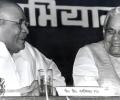
'Like General Patton, possibly the greatest exponent of the art of war, Vajpayee had the ability to be always on the offensive,' assesses Colonel Anil A Athale (retd).

An old fighter pilot remembers the best days of his life.

'Often reviled, mostly ignored, sometimes venerated, he has taken it all in his stride.' 'He has stood by the nation through thick and thin,' says Brigadier Gurmeet Kanwal (retd).

General T N Raina was an iconic Indian military leader whose contributions to the nation should be more widely known, notes Lieutenant General Syed Ata Hasnain (retd).
"It is the greatness of Ayodhya that the mosques surrounding the Ram temple are giving a strong message of communal harmony to the rest of the world," Haji Asad Ahmad, the corporator of the Ram Kot ward, told PTI.
'India is not the India of 1962. We are not carrying that baggage of history anymore.'
Moni Chadha was with Lal Bahadur Shastri in Tashkent. He counters colourful conspiracy theories with sobering facts.

Air Vice Marshal Arjun Subramaniam lists the major operational takeaways from the 1971 War in his new book 'India's Wars, A Military History, 1947-1971'.
Lieutenant General Harbakhsh Singh, GOC, Western Command, disobeyed the then army chief and took on a superior Pakistani armoured column. The Indian Centurion tanks outgunned the more modern Pakistani Patton tanks in the battle at Khem Karan, that proved the turning point of the 1965 War. Brigadier Gurmeet Kanwal (retd) salutes the Soldiers' General.
Decorated with a Vir Chakra for leading an attack that destroyed four tanks, Risaldar Ayub Khan shared a name with the Pakistani president who ordered the invasion of India in 1965. India's Ayub came from a family of soldiers and made his country proud.
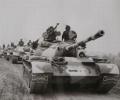
The 1965 war teaches us that war by escalation is a real possibility. Despite clear threats, Pakistan never believed that India will ever cross the international border. In the age of nuclear deterrence, this failure to deter Pakistan is the central lesson of 1965, says Colonel Anil Athale (retd).
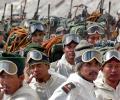
'India should stop claiming that a united Pakistan is in India's interests.' 'Pakistan's break-up is a necessity for peace and progress in the region,' says Major General Mrinal Suman (retd).
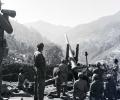
Fifty years ago, India and Pakistan fought a short but bloody war. The author finds out how Sainik Samachar, the defence ministry's journal, reported it.

50 years after the 1965 War, India still thinks we can have a 'limited war' when our opponent has time and again shown it does not believe in a limited war, says Colonel Anil A Athale (retd).

'Our policy seems to be to give away part of J&K, even though we are entitled to the entire state.' 'The Congress has done so, and the BJP is following the same policy.' 'No one is applying their mind to the legal position.' 'Kashmir is not a part of Pakistan under its own constitution.'

A lot of people only associate him with his music. And, obviously, he's a great musician. But Rahman, above all else, is a living example of spiritual equilibrium and intrinsic human goodness. A fascinating excerpt from Krishna Trilok's Notes Of A Dream: The Authorized Biography Of A R Rahman.

Syed Firdaus Ashraf speaks to Haji Syed Salman Chisti, Gaddi Nashi, Dargah Ajmer Sharif, the hereditary custodian of the dargah and the 26th generation descendant of Khwaja Garib Nawaz (as the Pir is known) to understand the meaning and significance of the gesture.
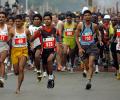
'Long Distance Running is not merely a sport, it's life's breath.' 'While everyone breathes so they can run, runners run so they can breathe,' says Krishna Kumar.
